
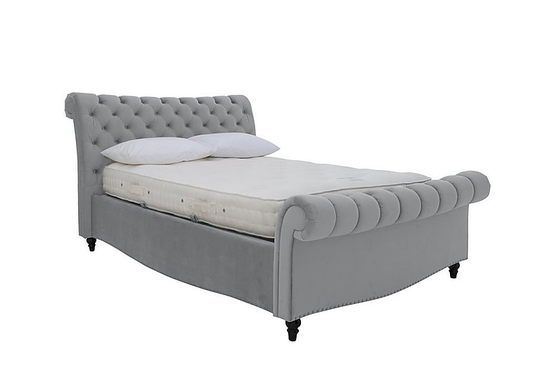
Around this time of year the spare room fills up with suitcases, wrapping paper and the summer duvet, just as guests are due for Christmas. An ottoman bed solves a lot of that, because the whole base lifts up to reveal storage the size of the mattress. They are not all built the same, though, and the details that matter most (the lift, the gas struts and the depth of the base) are easy to overlook when you are scrolling through photos online.
How An Ottoman Bed Works
An ottoman bed has a hinged platform that holds the mattress. When you pull the strap, gas struts (also called gas pistons) on each side take most of the weight and lift the mattress up, so you can reach the storage space underneath. Close it again and it looks like any other upholstered bed.
Compared with a divan with drawers, the big advantage is access. Drawers only use part of the space under the bed and need room beside the bed to pull out. An ottoman opens within its own footprint, so you can push it close to a wall or wardrobe and still use all of the storage.
End Lift Or Side Lift?
This is the first decision, and it depends on where the bed will stand.
- End lift (foot lift): the platform hinges at the headboard and rises from the foot end. It gives the widest opening and is the most common type. Choose it if there is open floor at the foot of the bed.
- Side lift: the platform hinges along one long side and lifts from the other. It suits narrow rooms, box rooms and beds pushed against a side wall, where the foot of the bed is close to a wall or door.
Before you choose, check the ceiling as well as the floor. In a loft room with a sloping ceiling, the raised mattress can hit the slope and stop the base opening fully. Measure the height of the slope where the end or side of the mattress will rise.
Gas Struts And Your Mattress
The struts are rated for a certain mattress weight, and this is where many ottoman beds disappoint. If the mattress is too heavy, the bed is hard to lift and the struts wear out faster.
As a rough idea, retailer guidance for a double ottoman suggests struts suited to a mattress of about 40 to 50kg, while a super king might need struts rated for 65kg or more. Always check two things before you buy:
- The weight of your mattress, which is usually listed in the mattress product details.
- The mattress weight range the bed manufacturer gives for its struts.
If you have a heavy hybrid or deep pocket sprung mattress, look for a bed that states it can handle that weight. Electric ottomans that lift at the press of a button are an option for anyone who struggles with lifting, but they cost more and need a socket nearby.
Storage Depth And What To Put In It
Most standard ottoman bases have an internal depth of around 20 to 25cm, and some deeper models go beyond 30cm. That difference decides what fits. Rolled duvets, spare pillows and seasonal clothes go in almost any ottoman. Hard suitcases, a boxed artificial Christmas tree or a stack of storage boxes need a deeper base.
Measure your bulkiest items before ordering. Whatever you store must sit below the corner brackets and hinges, or the bed will not close.
A few things that work well in an ottoman:
- Spare bedding for guests, kept together in one zipped bag per bed size.
- The out of season duvet. If you swap to a warmer winter duvet, roll the lighter summer one into a breathable storage bag. Our guide to choosing a duvet and tog rating explains how many tog you need for each season.
- Christmas decorations in shallow, labelled boxes.
- Winter coats and knitwear in vacuum bags during the summer months.
Avoid storing anything damp, and air the base now and then, especially in a bedroom prone to condensation.
Size, Room And Delivery
UK bed sizes are fairly standard: a double is 135 x 190cm, a king 150 x 200cm and a super king 180 x 200cm. The frame itself is larger than the mattress, and an upholstered headboard and footboard can add a surprising amount of length, so check the external dimensions in the product details rather than the mattress size.
Ottoman beds are heavier than ordinary bed frames and almost always arrive flat packed. That means three practical checks:
- Can the boxes get up the stairs and round the landing?
- Do you have time and help for assembly? The gas lift mechanism makes it more involved than a simple frame, and some people pay for an assembly service.
- Will you want to move the bed later? A heavy ottoman is awkward to shift between rooms, and the lift direction may not suit a different layout.
Base Board Or Slats?
Inside the frame, the mattress sits on either a solid board or slats. A solid platform gives an even, firm surface. Slats allow more airflow, but the gaps should be narrow: retailer guidance often quotes a maximum of around 7cm, because wider gaps can let a pocket sprung mattress sag between them. Check the mattress maker’s warranty terms, as some specify the type of base they expect.
Quick Checklist Before You Order
| Check | Why it matters |
|---|---|
| End lift or side lift | Must match the free space at the foot or side of the bed |
| Strut rating vs mattress weight | Too heavy is hard to lift and wears out the struts |
| Internal storage depth | Decides whether boxes and suitcases fit |
| External frame size | Upholstered frames are larger than the mattress |
| Ceiling height and slopes | The raised mattress needs clearance |
| Delivery route and assembly | Heavy flat packed parts and a more complex build |
If the spare room needs sorting before the guests arrive, start by measuring the room, weighing up which side of the bed is free and checking your mattress weight. Then browse the bedroom furniture section with those numbers in hand. A side lift model such as the Aurora side lift ottoman bed frame is worth comparing if your bed stands against a wall.